LLF Sponsors 2026 Science@Play Theme: An Exploration of AI the Threat and the Creative
(Livermore, CA) — “Science@Play has always been about experimentation, discovery, and dialogue,” said Lisa Tromovitch, SPARC Theater’s Executive/Artistic Director. “This year’s theme explores artificial intelligence (AI) — but the purpose is not to replace human playwrights. It’s to ask big questions about creativity: What can AI do and what can it never replicate about the human imagination?” The 2026 March festival consists of two offerings. The first is an AI experiment and discussion about what AI can and can’t do in the creative realm; how much human prompting and interaction is required to get it to produce something of quality; and the ramifications of using it. The reading will be of material generated by AI from structured prompts developed by Science@Play program director Michael Wayne Rice. The heart of the event will be the audience discussion afterwards. The second piece will be a new play commissioned by SPARC from playwright Cleavon Smith.
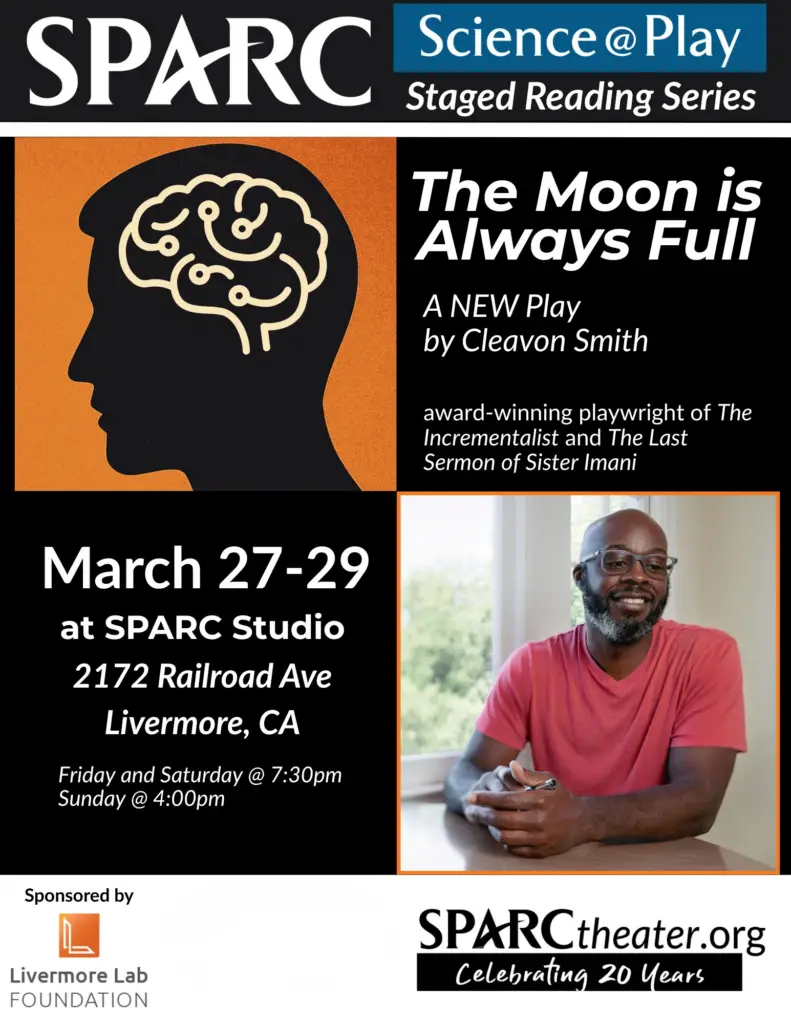
SPARC emphasizes its ongoing commitment to diverse voices and commissioned playwrights remains at the heart of the Science@Play program. Past seasons have highlighted diverse playwrights exploring scientific themes, and this year, the fifth year of the program, is no exception — Smith’s new play, The Moon Is Always Full, explores the possibilities and potential liabilities of brain implants enhanced with AI. Brain implants already assist people with Parkinson’s and seizures. Deep brain stimulation (DBS) interrupts electrical impulses that can cause movement problems. But what comes next as technology moves ahead? The play explores the ethical questions that arise as we see AI applications proliferating in medical science. Cleavon Smith will be in residence on Friday and Saturday, March 27th and 28th looking for feedback from a live audience as he prepares for the next draft of this new piece. The developmental process for playwriting reaches an exciting step when an early draft is ready for audience response. That time comes March 27-29 at SPARC’s downtown Livermore Studio.
The Livermore Lab Foundation (LLF) – a key philanthropic partner to Lawrence Livermore National Laboratory (LLNL) – is sponsoring Smith’s play. As LLF Executive Director Sally Allen noted, “The Foundation wanted to support The Moon Is Always Full because its theme relates to the work we’re funding at LLNL, where researchers are applying the Lab’s unique capabilities to model the human brain and tackle neurodegenerative diseases like ALS and Parkinson’s. By bringing these complex scientific concepts to the stage, we hope to build more understanding and dialogue around the potential of AI-driven medical innovation and the transformative impact it can have on human health and cognitive research.”
The March 13-15 program is the most controversial. A play developed as a collaboration between Rice and “Claude,” an LLM (large language model) will be read by professional actors. In addition to the performance, SPARC will host public discussions around not only the quality, or lack-thereof, of the piece but also about the ethical issues, and existential threats the use of AI in creative endeavors raises. SPARC hopes to bring artists, scientists, and community members together to reflect on the intersection of technology and creativity. “We hope for a mix of audience members to contribute to the discussion, those who are excited about AI and those who foresee problems with it. Broadening all of our perspectives takes on new importance when a technology is poised to alter society and the workforce in such a huge way,” commented Tromovitch.
Actors involved include Li-Leng Au, whose credits include a stint with the Royal Shakespeare Company (RSC) in London as well as SPARC Shakespeare in the Vineyard productions; Sierra Bolar, one of SPARCs lead teaching artists; Gregg Le Blanc, recently seen as Sir Toby Belch in SPARC’s Twelfth Night, and newcomer Bay Area actor Will Livingston.
For more information about Science@Play and SPARC Theater’s 2026 season, visit www.sparctheater.org.